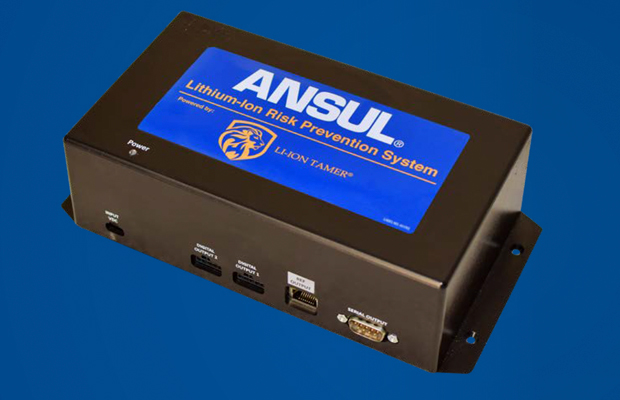
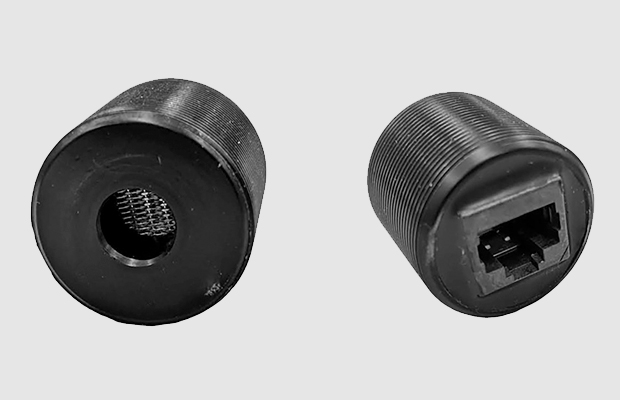
The ANSUL Lithium-Ion Risk Prevention System actively monitors lithium-ion batteries within the energy storage market. It provides early warning detection of off-gases/toxic vapors, signaling malfunctions within the battery cell. In fact, this proactive approach allows prompt action to be taken, helping prevent the occurrence of thermal runaway. As a result, Thermal runaway can cause the failure of a single cell to propagate, creating a domino effect into adjacent cells, resulting in a catastrophic event.
ANSUL Lithium-Ion Risk Prevention System is well suited to energy storage where Lithium-ion batteries are used.
The ANSUL Lithium-Ion Risk Prevention System – when combined with AUTOPULSE fire detection panels, ANSUL® INERGEN® Fire Suppression Systems or SAPPHIRE® Suppression Systems – identifies lithium-ion batteries that have off-gassed and provides the ability to help suppress fires by proactively activating alarms and releasing the fire suppression system.
Application
The system with a connected releasing panel and suppression system is particularly useful for early detection and suppression of fires in hazards where lithium-ion batteries are in use. Accordingly, typical applications include lithium-ion energy storage systems, lithium-ion battery test chambers and lithium-ion battery assembly rooms.
Key Features of the Lithium-Ion Risk Prevention System
Early warning of lithium-ion battery failures
Response time of less than 5 seconds to lithium-ion gases
Single cell failure detection without electrical or mechanical contact of cells
Compatible with all lithium-ion battery configurations and chemistries available today
Independent and redundant perspective on battery health
Several communication protocols including digital outputs and serial communication
The Lithium-Ion Risk Prevention System monitors lithium-ion batteries for off-gases and toxic vapors, providing early detection of malfunctions.
It prevents thermal runaway, thereby avoiding catastrophic failures across battery cells.
The system integrates with AUTOPULSE and ANSUL fire suppression systems to activate alarms and suppress potential fires.
Key features include rapid response to gas detection, compatibility with all battery configurations, and no need for direct contact for failure detection.
Typical applications involve energy storage systems, test chambers, and battery assembly rooms.